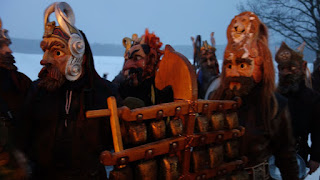
Walpurgis night, the pagan celebration of May 1
It's May 1st, 2022, and an old tradition can take place again after two years of cancellation due to the coronavirus pandemic.
In several locations throughout Germany, on April 30 people go up to the highest point in the area to light bonfires and drink and celebrate. It's a way of scaring away the last evil spirits of winter and welcome the brightness and promise of spring. Even in southern Germany, where the climate is warmer than equivalent latitudes in North America, night frosts can still happen into mid May.
 |
| Witches and devils on Walpurgisnacht (photo from nordbayern.de) |
In the Harz Mountains, just about every place is eerily decorated. In the town of Schierke, medieval bands and jugglers perform on various stages set up for the
event, and stalls are set up for selling arts and crafts. Other attractions include a chance to try archery, a medieval campsite, a Viking camp, taverns, fireworks and an after-party show. According to pagan myths, a "devil" named Wotan
married his love Freya on the night of April 30th at the highest peak in the Harz mountains, called the Brocken, which is near Schierke. The Brocken is mist-shrouded and cloud-wrapped 300 days of the year, so it is easily associated with eerie things.
In the town of
Wernigerode, Walpurgis night is celebrated in the central square and at
the castle, and witches storm the town hall.
 |
| Castle Wernigerode |
The ancient (Celtic) tradition of Beltane began on the night of April 30, lasting until the morning hours of May 1. It involved building bonfires and jumping over or walking between them. As a spring fertility festival, it used to involve lovers coupling in the fields to encourage a plentiful harvest.
The name Walpurgis is taken from St. Walburga, because her canonization occurred on the first of May. She is credited with converting the local Saxon pagans to Christianity and was invoked for protection against witchcraft. According to local folklore, she permitted witches their own festival one day of the year in exchange for their conversion to Christianity. The festival is associated with the end of winter and the beginning of spring. When this occurs, the separation between this world and the netherworld is thinnest, and the nearness allows the devils and witches to pass between the worlds. The legend of flying witches can be traced back to a herbal ointment that had an intoxicating effect on the women who used it. When they rubbed it in, they had the feeling of flying. In the middle ages, the preparation of the ointment was associated with witchcraft, which led to the legend of witches and devils.
The poet Johann Wolfgang von Goethe (Germany's Shakespeare) made the myths famous by incorporating them into his play "Faust", the story of the man who sold his soul to the devil.
 |
| from Praetorius' Blockes-Berges Verrichtung |
Goethe was not the only one who was inspired by Walpurgis night. Johannes Praetorius, a writer who lived from 1630 to 1680 and compiled literary works, including fairy tales and legends, wrote Blockes Berges Verrichtung (Blockula Performance), in 1668. He covered all the facets that he could gather on the belief in witches of the 17th century. He brought together skepticism and even contempt for various forms of witchcraft, but not against the belief in witchcraft.
 |
| Falero's Walpurgisnacht: Witches on their Sabbath |
Luis Ricardo Falero, a Spanish painter who lived from 1851 until 1896 and specialized in mythological, orientalist and fantasy settings, painted "Walpurgisnacht: Witches on their Sabbath".
Rimsky-Korsakov's orchestra piece, Night on Bald Mountain, published in 1886, gained wide exposure through the Walt Disney animated film Fantasia in 1940. The theme is the Witches' Sabbath on Walpurgis night.
The rising popularity of such festivals with ancient roots is another example of the increasing attraction and relevance of the pagan traditions in Germany. Such occasions are used as an excuse for a festival and to bring business to remote, economically disadvantaged regions. In spite of the peripheral commercial aspects, they become a primal communal experience as a spell settles over the audience during the performances. We described this in our blog entry about the Perchtentreiben performance we saw during Advent 2013. The communal response to the representation of natural forces is proving more attractive than the experiences organized religion offers. In Germany, "solidarity", or social cohesion, is still strongly encouraged through the centuries-old common traditions, among which are the beer gardens and the schools that teach the ability to function politely in a densely populated society. The number of Germans officially enrolled as members of the Roman Catholic, Lutheran or orthodox churches has dropped below 50% of the total population. It is significant that these old pagan traditions that in past centuries served the same purpose of reinforcing community are enjoying more interest than the ritual offerings of church institutions, whose antiquated moral restrictions and theology of suffering are perceived as increasingly irrelevant.
posted by Richard Trewin | 10:48 PM
|
0 comments